There is an old and reliable way to find out what something does: remove it and see what breaks. Surgeons and neuroscientists have done this for centuries — lesion a small region of tissue, watch which ability fades, and infer that the region was responsible for it. The word is ablation, literally a carrying-away, and it has become one of the few tools that gets inside a large language model at all. A modern model is a black box of billions of interacting knobs, and nothing can be read off it directly. So the next best thing gets done instead. A piece is taken away — a layer, an attention head, a training trick, a single direction in the model’s internal space — the model runs again, and the damage is measured. The size of the damage is the measure of the part’s importance. This piece is about how that removal is defined, how the number is read, and how little a small number proves.
Two meanings that share one logic
The word “ablation” covers two related but distinct activities, and both are worth naming before either is used.
The first is the ablation study, the workhorse of the research literature. Here the thing removed is a design decision. A model is built with some new component — a normalization scheme, an extra loss term, a different way of encoding position — and a claim is attached to it. A sceptic asks how anyone knows that piece is what helped, rather than something else changed at the same time. The ablation study answers by building an otherwise-identical model with that one component removed or replaced by something plain, training both, and comparing. If the full model scores better, the component earned its place. If the scores match, the component was decorative, which is worth knowing too.
The second is mechanistic ablation, the tool of interpretability research. Here the model is already trained and frozen, and the thing removed is not a design choice but a running part of the computation — the output of a particular attention head, the activity of a particular neuron, a specific pattern in the internal state — switched off mid-thought while the model processes one input. The goal is not to judge a design but to reverse-engineer a behaviour: to find which internal components actually carry out a capability the model already has.
Both share one logic, borrowed from the lesion studies of biology: establish that a part is responsible for an effect by removing the part and observing that the effect disappears. The difference is grain. One ablates ideas across whole training runs, the other ablates activity inside a single forward pass.
The theory: ablation is a causal experiment
It is worth being precise about why ablation licenses any conclusion at all, because the failure mode is self-deception. Observing that a component is active when the model does something well does not establish that the component caused the good behaviour — correlation is not causation, and in a densely connected model almost everything correlates with almost everything. Ablation is stronger than observation because it is an intervention. Rather than watching the system run and noting what co-occurs, it reaches in and changes one thing while holding everything else fixed, then measures the consequence. That is the defining move of a controlled experiment.
Formally, ablation estimates a counterfactual: not what the model does, but what it would have done, on this same input, had one part been absent. Call the model’s normal output on input $x$ the quantity $M(x)$, and the output with component $c$ removed $M_{\neg c}(x)$. The ablation effect is the gap:
$$\Delta_c = \text{score}\big(M(x)\big) - \text{score}\big(M_{\neg c}(x)\big)$$A large positive $\Delta_c$ means removing $c$ hurt, so $c$ was doing important work. A $\Delta_c$ near zero means the model barely noticed. That reading is ambiguous: either the part was unimportant, or another part took over its job. The two look identical from here, and separating them takes further experiments rather than a closer look at this number. Telling them apart is the whole discipline.
What can be ablated in a language model
The parts that can be carried away span every level of the model, from the coarsest architectural block to the finest thread of internal activity.
At the coarsest level sit whole architectural choices — an entire type of layer, the residual shortcut connections, a normalization step, a chunk of the training recipe such as a warm-up schedule or a data-cleaning stage. This is the territory of ablation studies. At a middle level sit structural components of the trained network — a specific layer, one attention head out of the dozens, the entire feed-forward stage of one block, or one expert in a mixture-of-experts model. At the finest level sit units of internal activity — a single neuron’s activation, a group of neurons, or a direction: a linear combination of activations that a probe or a sparse dictionary has identified as representing some concept, such as “this text is in French” or “the sentiment is negative”.
Ablation also works on the input and data side: remove a category of training data and retrain to see what knowledge vanishes, or remove part of the prompt to see how much the answer depended on it. And it works on information pathways rather than components — cutting the specific route by which one head’s output reaches another, while leaving both heads running. That last kind, path patching, traces not just which parts matter but how they talk to each other.
How ablation actually works: four ways to remove a part
Here the definition does real work, and getting it wrong corrupts everything downstream. In a physical brain, removing tissue is unambiguous. In a neural network, “remove” has to be defined, because every component outputs some number, and something has to be substituted when it is switched off. The choice matters enormously. There are four common answers.
The bluntest is zero ablation: force the component’s output to zero, as though it had never fired. Simple, and often misleading. Zero is not a neutral value. It may be a wildly out-of-distribution input the rest of the network has never seen, so the damage measured includes the shock of that unnatural zero and not only the loss of the component’s real contribution.
Gentler is mean ablation: replace the output with its average across many inputs. This removes the part’s ability to respond to the specific input — it now says the same bland thing regardless of context — while keeping its output in a realistic range. The question it answers is narrower than it looks: how much did it matter that this part could vary.
More careful still is resampling ablation, also called noising or interchange ablation: replace the output with the value it produced on a different, randomly chosen input. This destroys the information the component was carrying about this input while keeping every value statistically natural. It is the backbone of activation patching.
Finally there is the mirror image, activation patching in the positive direction, sometimes called causal tracing or restoration: instead of corrupting a healthy run, start from a corrupted run and paste in the clean activation of a single component, then watch whether that alone restores the correct answer. If restoring one small part flips the model back to correct, that part was carrying the crucial information. Ablation and patching are two ends of the same causal lever. One asks what breaks on removal, the other what heals on restoration.
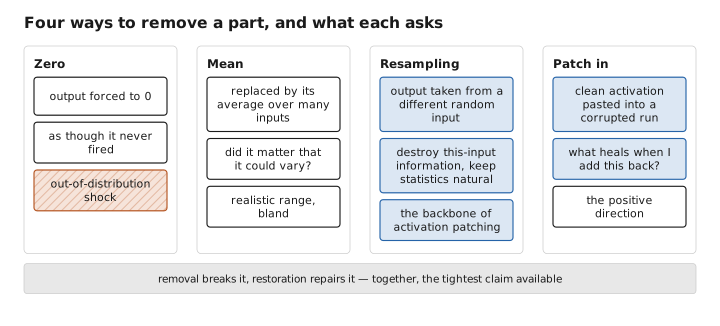
Figure 1. Four ways to remove a part, and what each asks.
How the damage is measured
Once a part is removed, the damage needs a number, and the choice of metric shapes what the number can support.
The most general metric is the change in the training loss, or its friendlier cousin perplexity, over a held-out set of text: the drop in probability the wounded model assigns to the correct continuations. For a targeted behaviour, a sharper metric is the logit difference — the gap between the raw score given to the correct answer and the score given to a specific wrong one. Such a gap is a log-odds ratio, so it reads naturally: a difference of one is a factor of about three in the relative odds. Ablating a head that shrinks the gap from a confident $+4.2$ to a hesitant $+0.3$ has caught that head doing most of the work of preferring right over wrong. For distributional questions, the KL divergence between the original output odds and the ablated ones measures how far the whole shape of the prediction moved. For end-task studies the metric can be accuracy on a benchmark, before and after. Whichever you pick, it is fixed before the sweep begins, because a metric chosen after the numbers are in is not a measurement.
Where to focus, and the traps that await
Ablation is powerful but treacherous, and most of the skill is knowing where to point the suspicion.
The deepest trap is redundancy and self-repair. Large models often spread a capability across several components, so removing any one barely moves the metric — not because none matters, but because the survivors compensate. Some models actively self-repair: ablate one head and a downstream component notices the disturbance and adjusts to undo it, hiding the effect. A small $\Delta_c$ therefore does not establish that a part is useless. The remedy is to ablate groups of related components together rather than one at a time. Then check the story survives.
A second trap is interaction effects. Two components may each look useless alone and be jointly essential, or one may help only in the presence of another. Single-part ablations miss this entirely. Hence combinations, and hence the drift toward path-based methods that respect how parts cooperate.
A third is the out-of-distribution shock already named: an ablation that shoves the network into a state it never occupies during normal running produces large damage reflecting the shock, not the lost function. This is why resampling ablation, which keeps every value plausible, is preferred for careful causal claims.
Finally, in ablation studies of design choices, the classic trap is changing more than one thing at a time. A model that differs from its baseline in three ways at once yields a score difference that says nothing about which of the three was responsible. The entire value of an ablation study rests on removing exactly one thing and holding all else — data, training steps, random seed, everything — fixed.
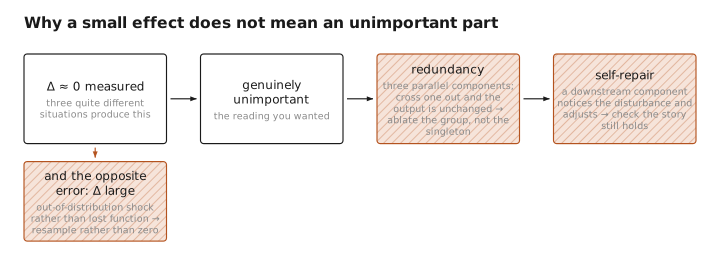
Figure 2. Why a small effect does not mean an unimportant part.
A full worked example: finding the head that decides who received the gift
One complete mechanistic ablation, from beginning to end and with concrete numbers, puts the whole method in one place. The task is a simplified version of a classic interpretability probe.
The behaviour. A small trained language model is given the sentence “When Mary and John went to the shop, John handed a drink to ____” and asked for the next word. A competent model answers “Mary”, not “John”. The logic a human uses is that John is the giver, having already appeared as the subject of “handed”, so the other name must be the receiver. The question is which internal parts carry out that piece of reasoning — specifically the part that suppresses the already-used name and promotes the unused one.
The metric. The logit difference between the two candidates:
$$\text{logit-diff} = \text{logit}(\text{"Mary"}) - \text{logit}(\text{"John"})$$On the intact model this comes out at +3.6, a firm preference for the correct name. That number is the thermometer, and every ablation is judged by how far it drops.
The suspects. Suppose the model has 12 layers with 12 attention heads each, 144 heads in all. Inspecting all 144 by hand is not a plan. The sweep is systematic.
The intervention. Each head in turn receives a resampling ablation: take a corrupted version of the sentence with the names swapped or scrambled, record what that head outputs there, and paste that value in place of the head’s real output on the clean sentence. This destroys the sentence-specific information the head was carrying while keeping its output realistic. Then recompute the logit difference. Record the fall.
The results. Most heads barely move the number — the logit difference stays near +3.6, which places them outside this task. A handful stand out. Written as the ablation effect $\Delta = 3.6 - (\text{logit-diff after ablating})$:
| Head (layer.head) | Logit-diff after ablation | Effect $\Delta$ | Reading |
|---|---|---|---|
| 9.9 | +0.4 | +3.2 | Enormous — carries most of the decision |
| 9.6 | +1.5 | +2.1 | Large — a second major contributor |
| 10.0 | +2.0 | +1.6 | Substantial |
| 10.7 | +4.3 | −0.7 | Negative — this head was working against the answer |
| 3.0 | +3.5 | +0.1 | Negligible |
| (the other 139) | ≈ +3.6 | ≈ 0 | Irrelevant to this task |
The reading. Three heads — 9.9, 9.6, 10.0 — account for almost the entire preference for “Mary”: switch them off and the model is nearly a coin-flip between the two names. In the interpretability literature these are name-mover heads, attending from the final position back to the unused name and copying it forward. The negative entry, head 10.7, is as informative. Ablating it raised the logit difference, so it was pushing toward the wrong answer. Such heads exist, often acting as calibrators that keep the confident heads from overshooting, and they are findable only because ablation reports signed effects rather than magnitudes.
The confirmation. The sweep is not the end, because of the redundancy trap. Two follow-ups seal the case. First, ablate the three top heads together: the logit difference collapses to roughly −0.2, so as a group they are not merely helpful but necessary — without them the model slightly prefers the wrong name. Second, run the mirror experiment: start from the fully corrupted sentence, where the logit difference sits near zero, and patch back in only head 9.9’s clean output. If that single restoration lifts the difference most of the way to +3.6, the head is not only necessary but nearly sufficient to carry the information. When removal breaks the behaviour and restoration repairs it, the causal claim is about as tight as this kind of evidence gets.
And what it does not settle. Out of 144 heads, a findable circuit of about three implements “promote the name that was not already used”, with at least one other acting as a brake. None of that was visible from watching the model run. But the experiment establishes that those heads are causally involved and nothing more: it does not say what the heads represent, whether the same circuit fires on a sentence with three names, or whether a larger model solves the task this way at all. The article on chain-of-thought faithfulness makes the same point about a different object — causal involvement and description are separate properties, and only the first is what this method returns.
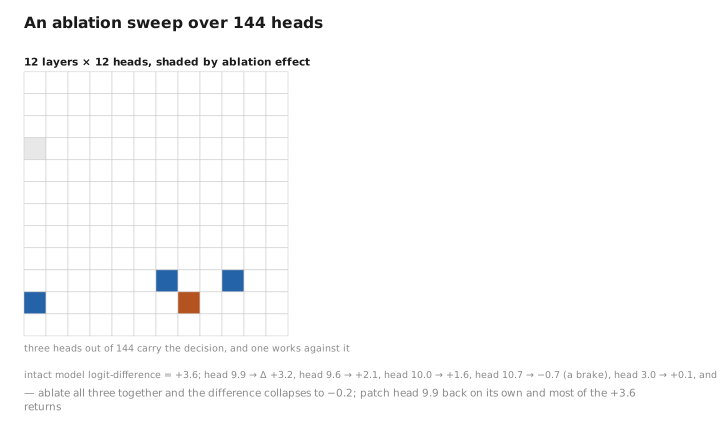
Figure 3. An ablation sweep over 144 heads.
What to carry forward
Ablation is the practice of understanding a model by removing a part and measuring how much worse it gets — a controlled, causal experiment rather than a passive observation. It comes in two forms that share one logic: the ablation study, which removes a design choice across whole training runs to establish that the choice earned its keep, and mechanistic ablation, which switches off a running component mid-computation to reverse-engineer a behaviour. Because removing a part of a network is ambiguous, the definition matters — zeroing, mean-replacing, or most rigorously resampling from other inputs — and so does the metric, whether loss, logit difference or KL divergence. The great pitfalls are redundancy and self-repair, which make important parts look unimportant, and confounds, which let one change masquerade as another; the discipline is removing exactly one thing, testing groups as well as singletons, and confirming that what breaks on removal heals on restoration. The reading it supports is narrower than the effort suggests. A large effect may be the shock of an unnatural input rather than a lost function. A small one proves nothing at all while a survivor can compensate. And even a clean result establishes that a component is causally involved without saying what it represents, which is a narrower finding than the effort suggests — the worked example above pins three heads to one sentence pattern, and says nothing about what those heads do anywhere else.
The figures in this article follow the shared figure key , which explains what every shape, line style and colour means.
