LoRA removed most of the price of adapting a giant model: only a small pair of narrow grids trains, and the original stays frozen. That collapses the training bookkeeping to almost nothing. One obstacle survives it. Training a small set of new knobs still requires holding the entire frozen model in memory throughout — all those billions of original numbers have to sit there so the calculations can flow through them. For the largest models that alone can demand hundreds of gigabytes, far beyond a single ordinary graphics card. QLoRA — Quantized Low-Rank Adaptation — is the trick that knocks down this last wall. The idea is direct: if the frozen model is what consumes the memory, store the frozen model in a more compact form. This piece is about how the compression works, why the rounding survives it, and what the saving does not reach.
Where the memory actually goes
To see the fix, first see the problem clearly. Every knob in a model is a number, and a number has to be stored in some number of bits. By default, models are trained using numbers that each occupy sixteen bits — a good balance of range and precision. Multiply sixteen bits by tens of billions of knobs and you arrive at those hundred-gigabyte memory bills. LoRA does nothing to change this, because the frozen base still has to be present in full during the forward pass. So the question becomes: do we truly need sixteen bits per knob just to read the model, or could we get away with fewer?
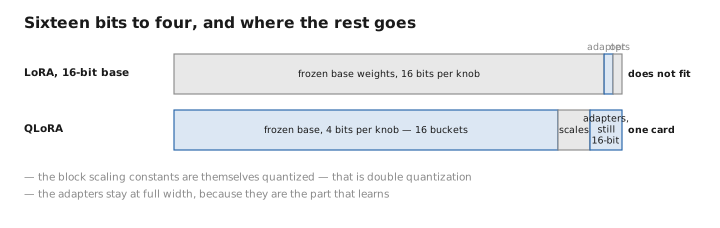
Figure 1. Sixteen bits to four, and where the rest goes.
Quantization: describing each number in fewer bits
Storing a number in fewer bits is called quantization, and the intuition is everyday. Think of describing people’s heights. You could record each one to the millimetre — precise but bulky. Or you could round everyone to the nearest of a small set of buckets — “short, medium, tall, very tall” — which loses fine detail but takes far less room. Quantization does exactly this to a model’s knobs: instead of sixteen bits of precision per number, it snaps each one to the nearest value in a small, agreed-upon set, and stores only which bucket it landed in. QLoRA pushes this down to just four bits per knob — sixteen possible buckets — cutting the memory for the frozen model to roughly a quarter of its former size. A model that needed a small cluster suddenly fits on a single card.
The obvious worry is that rounding every knob so aggressively would wreck the model’s carefully learned intelligence. QLoRA’s craft is in rounding cleverly enough that it barely does. Three ideas do the heavy lifting.
Three refinements that keep the intelligence intact
The first is choosing the buckets to match how the numbers are actually distributed. A model’s knobs are not spread evenly; they cluster tightly around zero, with only a few large values out at the edges. Spacing the buckets evenly would waste most of them on empty territory and leave the crowded middle poorly resolved. QLoRA instead uses buckets spaced so that each one holds roughly the same share of the knobs — fine-grained where the values are dense, coarse where they are sparse. This scheme, built to suit the bell-shaped spread that weights naturally follow, is what lets four bits capture so much more fidelity than four bits normally would.
The second refinement recognizes that quantization is done in small blocks, and each block needs a scaling number recorded so its buckets can be sized correctly. With many small blocks, those scaling numbers start to add up to real memory of their own. QLoRA’s answer is to apply the method to itself: it quantizes the scaling numbers too, compressing the compression bookkeeping. Small on its own, this “double” step trims meaningful overhead across a whole model.
The third refinement is a memory-management trick for the training run itself. During fine-tuning, occasional spikes in memory demand can overflow a card and crash everything. QLoRA lets these overflows spill into ordinary system memory and flow back when the pressure passes — a pressure-release valve that keeps a run from dying at its most demanding moments, at the cost of a little speed.
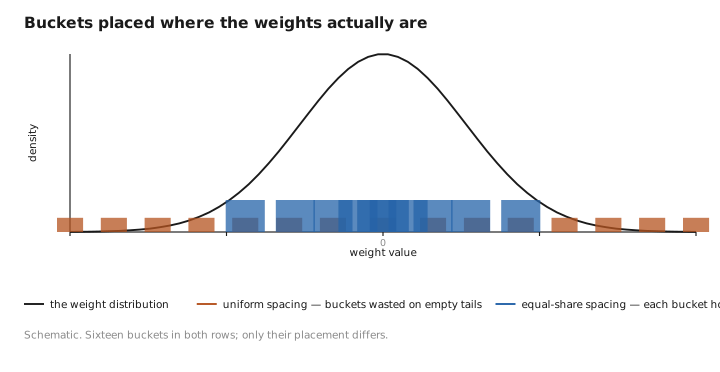
Figure 2. Buckets placed where the weights actually are.
The crucial split: store in four bits, compute in sixteen
Now the central subtlety, and the piece that makes the whole scheme honest. The four-bit form is used only for storage. The moment the model actually needs to compute with a chunk of its knobs, QLoRA temporarily expands that chunk back up to sixteen-bit numbers, does the math at full precision, and then discards the expanded copy. Storage is cheap and permanent; the precise form is expensive but fleeting, conjured only for the instant it is needed and never held all at once.
$$W_{\text{4-bit}} \;\xrightarrow{\text{expand on demand}}\; W_{\text{16-bit}} \;\xrightarrow{\text{used in}}\; W_0 + BA$$Meanwhile the LoRA adapters — the little skinny grids $A$ and $B$ described above — are kept in full sixteen-bit precision the whole time, because they are the part that is actually learning and they are tiny enough to afford it. So the model’s vast frozen knowledge sits compressed in four bits, decompressed in small pieces only as calculations sweep through it, while the small, precious, trainable part stays sharp. The frozen giant is stored cheaply; the learning happens in full fidelity on the side.
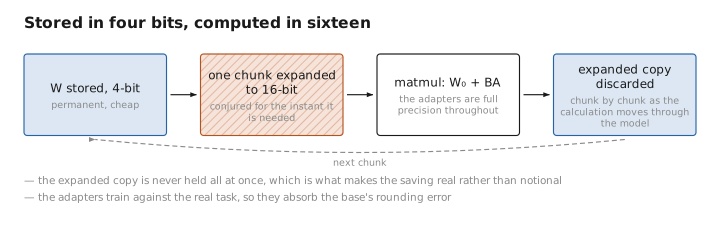
Figure 3. Stored in four bits, computed in sixteen.
Why the rounding does not ruin the result
Rounding a model this hard and still fine-tuning it to near-full quality looks implausible. Two things carry it. First, the refinements above mean the four-bit copy is a genuinely faithful likeness of the original — close enough that computations flowing through it come out nearly unchanged. Second, and more subtly, the errors introduced by rounding the frozen base are exactly the kind of thing the trainable adapters can absorb. Because $A$ and $B$ are learning in full precision against the real task, they naturally adjust to compensate for the small distortions of the quantized base, steering the final result back on course. The precise, learning part absorbs the imprecision of the frozen one. The upshot, demonstrated repeatedly in practice, is that QLoRA fine-tuning reaches quality indistinguishable from full sixteen-bit LoRA — while fitting a model many times larger onto the same hardware.
What it changed
The practical consequence is hard to overstate. Fine-tuning the very largest open models had been the preserve of organizations with serious clusters. QLoRA brought it down to a single high-end graphics card of the sort a hobbyist or small lab might own. It democratized adaptation: the combination of a frozen, four-bit base and a handful of full-precision LoRA adapters means almost anyone can take a state-of-the-art model and teach it their own speciality over a weekend. It is LoRA’s insight — freeze the giant, train a sliver — carried to its logical end by refusing to pay full price for storing the giant at all.
What to carry forward
QLoRA removes the last barrier that plain LoRA left standing: the need to keep the whole frozen model in memory at full precision. It quantizes that frozen base down to four bits per knob — storing each number as the nearest of sixteen buckets, chosen to match how weights are really distributed — which shrinks the model to roughly a quarter of its size. The four-bit form is used only for storage; each chunk is briefly expanded back to full precision exactly when it is needed for computation, then thrown away. The small LoRA adapters stay in full precision and do all the learning, and because they train against the real task they quietly absorb the rounding errors of the compressed base. The result is fine-tuning of the largest models on a single graphics card, at quality that rivals the far more expensive full-precision approach. What it buys is access to the training stage and nothing beyond it: the served model still has to be quantized on its own terms, as the article on inference quantization sets out, and the frozen base is as frozen as it was under plain LoRA, so the same constraint on what an adapter can move applies here too, on cheaper hardware.
The figures in this article follow the shared figure key , which explains what every shape, line style and colour means.
